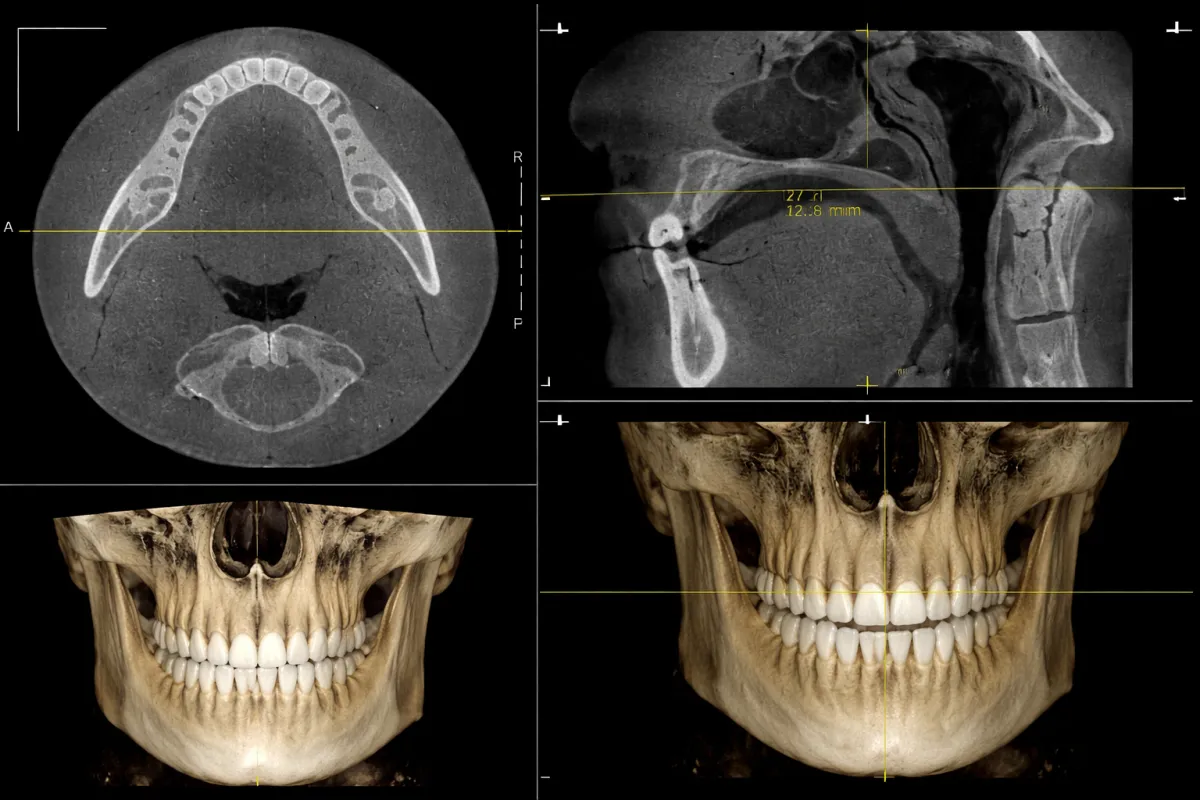
Are Dental CBCT's Overdone To Generate Revenues?
Dental CBCT imaging is frequently obtained in routine TMD workups, often reflecting revenue-generating billing patterns rather than diagnostic necessity...“Unbundling”, which is separating a single procedure into multiple billable components when a single code is appropriate, is widely recognized as a form of insurance fraud, a principle that also applies to imaging services when a single dental CBCT is billed as multiple medical X-rays.
Cone beam computed tomography (CBCT) is now a "routine" imaging modality in dentistry, particularly for implant planning, pathology detection, and complex surgical evaluation. Three-dimensional imaging can indeed provide clinically relevant information that conventional dental radiographs may miss. However, the routine use of CBCT in evaluations for temporomandibular disorders (TMD) and dental sleep apnea is colloquially speaking "on steroids" well beyond what current evidence supports.
Is CBCT imaging is being driven primarily by clinical necessity or by the financial incentives associated with in-office imaging technology?¹
Temporomandibular disorders are clinical diagnoses. The Diagnostic Criteria for Temporomandibular Disorders (DC/TMD), widely used in both clinical practice and research, rely largely on patient history and physical examination findings rather than advanced imaging.² Imaging may be appropriate when degenerative joint disease, trauma, or other structural abnormalities are suspected, but routine CBCT imaging for every patient presenting with jaw pain is not supported by current evidence or guidelines.
When advanced imaging is indicated for evaluation of temporomandibular joint before surgery or perplexing clinical dilemmas, then magnetic resonance imaging (MRI) is considered the preferred modality for detecting disc displacement and joint effusion, whereas CBCT primarily evaluates bony structures.³ Similarly, when head and neck cancers and tumors are suspected, MRI or medical grade CT scan with contrast provide superior soft-tissue contrast compared with dental CBCT.⁴ Despite these limitations, CBCT imaging is frequently obtained in routine TMD workups, often reflecting revenue-generating billing patterns rather than diagnostic necessity.
A similar trend has emerged in dental sleep apnea practices. CBCT airway scans are sometimes marketed as tools to evaluate airway size or predict obstructive sleep apnea (OSA). The problem is that OSA is fundamentally a multifactorial pathological disorder characterized by sleep-related airway collapse, not simply an anatomic narrowing visible on imaging.⁵ CBCT imaging captures a static snapshot of airway anatomy while the patient is awake and upright, but these conditions differ substantially during sleep. Numerous studies have demonstrated that airway dimensions measured on CBCT do not correlate with severity of obstructive sleep apnea measured during sleep testing.⁶ Hence, major sleep medicine guidelines continue to emphasize that polysomnography or validated home sleep apnea testing remains the standard for diagnosis, rather than imaging-based airway measurements.⁵
The expanding availability of CBCT units in dental offices has also introduced a financial incentive within practice economics. This phenomenon has been described across healthcare whenever diagnostic technology becomes financially linked to treatment pathways. In certain airway-focused or TMD dental practices, CBCT scans are obtained routinely despite limited evidence that they meaningfully change diagnosis or management. But the overuse of CBCT's is an easy way to enhance practice revenues.
Clinicians should also be aware that certain billing practices involving CBCT imaging have raised regulatory concern. In healthcare billing, “unbundling”, which is separating a single procedure into multiple billable components when a single code is appropriate, is widely recognized as a form of insurance fraud, a principle that also applies to imaging services when a single dental CBCT is billed as multiple medical X-rays.⁷
As my 2022 Toyota Rav4 Hybrid is a recurring theme of my blogs, I can safely postulate that I could upgrade my car by "routinely" selling CBCT's to TMD and sleep apnea patients.
References
American Dental Association Council on Scientific Affairs. The use of cone-beam computed tomography in dentistry: an advisory statement from the ADA Council on Scientific Affairs. J Am Dent Assoc. 2012;143(8):899-902.
Schiffman E, Ohrbach R, Truelove E, et al. Diagnostic Criteria for Temporomandibular Disorders (DC/TMD) for clinical and research applications. J Oral Facial Pain Headache. 2014;28(1):6-27.
Larheim TA, Westesson PL. Maxillofacial Imaging. 2nd ed. Springer; 2017.
Som PM, Curtin HD. Head and Neck Imaging. 5th ed. Mosby; 2011.
Kapur VK, Auckley DH, Chowdhuri S, et al. Clinical practice guideline for diagnostic testing for adult obstructive sleep apnea. J Clin Sleep Med. 2017;13(3):479-504.
Schwab RJ. Upper airway imaging in obstructive sleep apnea. Proc Am Thorac Soc. 2008;5(2):185-191.
U.S. Department of Health and Human Services Office of Inspector General. Fraud and abuse considerations in diagnostic imaging billing practices. HHS-OIG guidance documents.