Myofunctional Therapy Has No Proven Role In Treating Sleep Apnea Or Temporomandibular Disorders
In Plainspeak, selling tongue exercises as a replacement for CPAP, oral appliance therapy, or appropriate medical management (for sleep apnea) is not evidence-based practice.
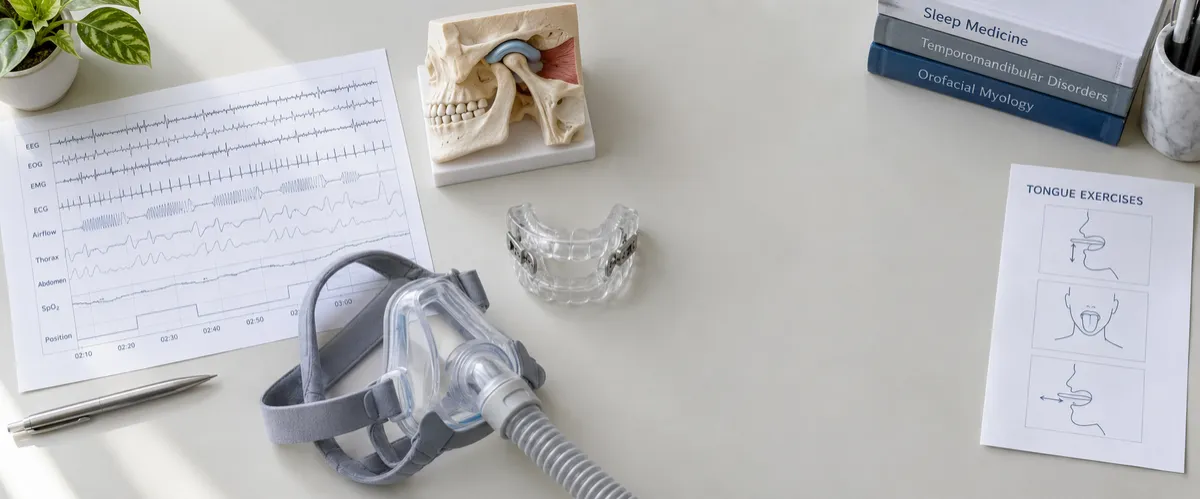
Myofunctional therapy is a program of exercises intended to retrain how the tongue, lips, cheeks, and other muscles of the mouth and face rest and move. Treatment typically consists of repeated tongue, lip, and cheek exercises, along with daily home practice, promoted as retraining oral resting posture and breathing patterns. Myofunctional programs may require weeks or months of paid sessions, overpromise their efficacy and remain a costly out-of-pocket expense usually not covered by medical or dental insurance. Parts of the dental community who market themselves as "Airway Dentists" have expanded it into a sweeping treatment for temporomandibular disorders (TMD) and obstructive sleep apnea (OSA). The sales pitch often blames low tongue posture, weak oral muscles, mouth breathing, or an improper swallow, and promises that exercises will correct the airway and unload the jaw joints.
For OSA, myofunctional therapy may be somewhat effective under the right hands and appropriate protocols only. A 2024 meta-analysis of seven randomized controlled trials involving 310 patients found improvements in adult apnea-hypopnea index (AHI), daytime sleepiness, sleep quality, and minimum oxygen saturation compared with sham therapy or no treatment [1]. But a Cochrane review found that the certainty of evidence ranged from moderate to very low, long-term outcomes were largely unknown, and myofunctional therapy did not perform like CPAP [2]. The American Academy of Dental Sleep Medicine subsequently concluded that there is insufficient evidence that myofunctional therapy prevents or cures OSA and remained uncertain about recommending it as primary stand-alone therapy [3]. A 2026 umbrella review reached a similar verdict: benefits appear consistent but limited, while the overall certainty of evidence remains very low [4]. In Plainspeak, selling tongue exercises as a replacement for CPAP, oral appliance therapy, or appropriate medical management is not evidence-based practice.
Myofunctional therapy is even less impressive for managing TMD and it should not be confused with physical therapy for TMJ Disorders, which are proven to be effective. A systematic review located only four randomized controlled trials, three of which reported some benefit, but the authors explicitly characterized the overall evidence as weak [5]. Jaw exercises, habit awareness, supervised stretching, postural exercises, and manual therapy can all be legitimate parts of conservative TMD management. Current clinical guidelines support several of these approaches [6]. But none of this proves that abnormal tongue posture causes TMD, that every patient with jaw pain requires a myofunctional therapist, or that a frenectomy is the missing treatment.
Myofunctional therapy is also being sold together with frenectomy as an OSA treatment for children and adults. There is no established efficacy for this combination in either population. The AADSM consensus found insufficient evidence to use lingual or buccal releases to prevent, manage, or cure OSA in children or adults.[3] The pediatric American Academy of Otolaryngology-Head and Neck Surgery consensus is unequivocal: ankyloglossia does not cause sleep apnea.[7] A 2025 publication promoting myofunctional therapy with frenectomy described only a single adult case and acknowledged that further research was necessary.[8] Scant case reports as are presented my "Airway Dentists" and prospective studies without adequate controls cannot be considered strong evidence.
A 2026 article in JADA is an evidence synthesis of the 2024 AADSM consensus I have cited earlier. It found that no emerging new dental therapy except mandibular advancement device qualified as first-line monotherapy for OSA or snoring.[9] The 2026 American Association of Orthodontists white paper addresses the orthodontist’s role in OSA.[10] It provides no basis for presenting myofunctional therapy as an established treatment for either sleep apnea or TMD.
The clinical conclusion is simple: do not sell myofunctional therapy as treatment for OSA or TMD, do not use it to justify frenectomy, and do not let tongue exercises delay an accurate diagnosis or proven care. A recent small randomized trial found that six months of regular shankh, or conch-shell, blowing, essentially playing a natural trumpet against resistance, reduced daytime sleepiness and AHI while improving sleep quality in adults with moderate OSA. Based on this paper I sometimes recommend patients try blowing balloons to improve their airway functioning. [11]
If only I practiced the tenets of what is called "Airway Dentistry" and began advocating palatal expansion, frenectomy, and hired a "myofunctional therapist" in my practice, my 2024 Toyota Rav4 Hybrid would be long upgraded.
References
1. Saba ES, Kim H, Huynh P, Jiang N. Orofacial myofunctional therapy for obstructive sleep apnea: A systematic review and meta-analysis. Laryngoscope. 2024;134(1):480-495. [doi:10.1002/lary.30974](https://doi.org/10.1002/lary.30974)
2. Rueda JR, Mugueta-Aguinaga I, Vilaró J, Rueda-Etxebarria M. Myofunctional therapy (oropharyngeal exercises) for obstructive sleep apnoea. Cochrane Database Syst Rev. 2020;11(11):CD013449. [doi:10.1002/14651858.CD013449.pub2](https://doi.org/10.1002/14651858.CD013449.pub2)
3. Sheats R, Masse JF, Levine MR, et al. Novel therapies for preventing, managing and treating obstructive sleep apnea and snoring in pediatric and adult patients. J Dent Sleep Med. 2024;11(2). [doi:10.15331/jdsm.7332](https://doi.org/10.15331/jdsm.7332)
4. Justribó-Manion C, Sánchez-Romero EA, Cuenca-Zaldivar JN, et al. Active conservative interventions for obstructive sleep apnea: An umbrella review and meta-meta-analysis of systematic reviews. Sleep Med. 2026;138:108665. [doi:10.1016/j.sleep.2025.108665](https://doi.org/10.1016/j.sleep.2025.108665)
5. Melis M, Di Giosia M, Zawawi KH. Oral myofunctional therapy for the treatment of temporomandibular disorders: A systematic review. Cranio. 2022;40(1):41-47. [doi:10.1080/08869634.2019.1668996](https://doi.org/10.1080/08869634.2019.1668996)
6. Busse JW, Casassus R, Carrasco-Labra A, et al. Management of chronic pain associated with temporomandibular disorders: A clinical practice guideline. BMJ. 2023;383:e076227. [doi:10.1136/bmj-2023-076227](https://doi.org/10.1136/bmj-2023-076227)
7. Messner AH, Walsh J, Rosenfeld RM, et al. Clinical consensus statement: Ankyloglossia in children. Otolaryngol Head Neck Surg. 2020;162(5):597-611. [doi:10.1177/0194599820915457](https://doi.org/10.1177/0194599820915457)
8. Ng E, Weaver K, Talwar R. Critical importance of orofacial myofunctional therapy and surgical technique in frenectomy for OSA: A clinical case report. J Dent Sleep Med. 2025;12(2). [doi:10.15331/jdsm.7388](https://doi.org/10.15331/jdsm.7388)
9. Simmons M, Sheats R, Meira E Cruz M. Emerging dental therapies for sleep disorders: Evidence synthesis from the American Academy of Dental Sleep Medicine 2024 consensus. J Am Dent Assoc. 2026;157(1):10-19. [doi:10.1016/j.adaj.2025.10.010](https://doi.org/10.1016/j.adaj.2025.10.010)
10. Palomo JM, Cohen-Levy J, Flores-Mir C, et al. Sleep-disordered breathing and orthodontics: An American Association of Orthodontists white paper update. Am J Orthod Dentofacial Orthop. 2026;169(4):419-427. [doi:10.1016/j.ajodo.2026.01.014](https://doi.org/10.1016/j.ajodo.2026.01.014)
11. Sharma KK, Gupta R, Choyal T, et al. Efficacy of shankh blowing on moderate sleep apnoea: a randomised control trial. ERJ Open Res. 2025;11(6):00258-2025. [doi:10.1183/23120541.00258-2025](https://doi.org/10.1183/23120541.00258-2025)